
 Tansen
- The Magical Musician
Tansen
- The Magical Musician
|
|
|
|
|
Almost exactly in the centre of India is a town called
Gwalior. In this town is the tomb of Tansen, one of the greatest musicians that
ever lived.Next to his beautifully carved stone tomb stands a little tamarind
tree. It is believed that by eating a leaf of this tree and touching the tomb, a
singer can improve his voice.
If this sounds like magic, the story of Tansen is equally magical. Even today,
many famous musicians follow the style of music created by Tansen known as the "Gwalior
Gharana".
About four hundred years ago, in a village near Gwalior, lived a wealthy poet,
Mukand Mishra, and his wife. Their only sorrow was that they had no children. On
the suggestion of a friend, Mishra went to Gwalior to seek the blessings of the
famous saint and musician, Mohammad Ghaus. He tied a holy thread on Mishra's
arm, saying, "May God bless you with a son." And so it came to pass. A child was
born and named Tansen. As Tansen grew up his father engaged teachers to teach
him to read and write. Tansen, however, was more interested in going to the
nearby forest with his friends, where he would imitate bird and animal sounds.
 Once
a group of singers were passing through the forest. Tansen hid himself in some
bushes and roared like a tiger. So life-like was the sound that the singers
became frightened. When the boy showed himself, the leader of the group praised
his tiger-like roar. Encouraged, Tansen made more animal and bird sounds.
Once
a group of singers were passing through the forest. Tansen hid himself in some
bushes and roared like a tiger. So life-like was the sound that the singers
became frightened. When the boy showed himself, the leader of the group praised
his tiger-like roar. Encouraged, Tansen made more animal and bird sounds.
The leader was greatly impressed by Tansen's performance. He was none other than
the famous music teacher, Haridas.
Haridas offered to take Tansen as his disciple. "He has great musical talent,"
said Haridas to Tansen's father. Most reluctantly, Tansen's mother agreed to let
her only child go away to Brindaban to study under Haridas. For almost ten years
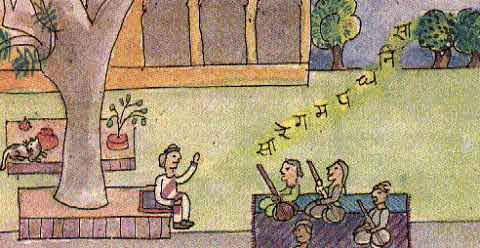
Tansen studied music from Haridas. Starting with the basic musical notes SA RE
GA MA PA DHA NI SA, he learnt the basics of singing and playing the tanpura. He
learnt about the different ragas of Indian music and how each raga creates a
different mood. A raga can make you so happy that you want to dance, or it can
make you so sad that it brings tears to your eyes.
Then one day there was a message from home that his father was very ill. When
Tansen arrived home he found his father on his death-bed.
"I am happy that you have become a musician. Go and see Mohammad Ghaus," were
his father's last words to him.
Tansen remained at home to look after his mother, but within a year she, too,
died.
Now Tansen was free to keep his promise to his father to go to Mohammad Ghaus
and be trained by him. But, in keeping with Indian tradition, he went to seek
permission to learn under a new guru from his first guru, Haridas.
"You must obey your father's wishes, but you will always be welcome here. You
are like a son to me," said Haridas. And he gave him his blessings.
Tansen studied under Mohammad Ghaus for three years, developing his musical
talent.

During that time Mohammad Ghaus introduced Tansen to the ruler of Gwalior. They
became good friends and Tansen would often visit the ruler's palace, where he
would listen to other musicians.
During his visits to the palace, Tansen met Husani, one of the women who
attended on the ruler. Like her name "the beautiful one", Husani was truly
beautiful. Tansen fell in love with her and married her.
A few years later Mohammad Ghaus died, leaving his property and money to Tansen.
Tansen settled in Mohammad Ghaus's house and his family was raised there. One
day a messenger arrived from the court of Rewa, near Gwalior. The messenger
opened the scroll and read: "King Ramchandra of Rewa would like you to be a
musician at his court."
This was a great honour and the first step in Tansen's rise to fame.
 King
Ramchandra admired Tansen's singing and lavished many expensive gifts on him.
Once he gave him a thousand gold coins.
King
Ramchandra admired Tansen's singing and lavished many expensive gifts on him.
Once he gave him a thousand gold coins.
Then one day the Emperor, Akbar, went on a visit to Rewa. King Ramchandra
arranged for Tansen to entertain his royal guest.
The emperor was greatly impressed by Tansen's music and, soon after his return,
sent a message to Ramchandra requesting him to send Tansen to his court.
King Ramchandra did not want to part with Tansen, but he could not afford to
displease the powerful Akbar. After all, Akbar was the Emperor of India, and
Ramchandra was only the king of a small state in Akbar's empire.
So, reluctantly, King Ramchandra sent Tansen as a royal gift from one court to
another escorted by his own men.
Tansen received a royal welcome in the capital city of Agra. Akbar was so
impressed by Tansen's music that he bestowed on him the highest honour of the
land. Tansen was included among his navratna, nine jewels – the nine most
outstanding talents of the royal court.
Besides performing in the court, Tansen would often sing alone for the Emperor.
At night he sang ragas that would soothe and help Akbar fall asleep, and in the
morning Tansen sang special ragas that would gently awaken the Emperor.
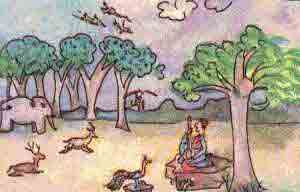
There are many stories told about the power of Tansen's music. It is said that
when Tansen sang, birds and animals would gather to hear him.
Once, during a hunting expedition, Emperor Akbar
spotted a white elephant which he wanted for himself. The elephant was captured
and brought to the palace. The elephant, however, was fierce and wild and would
not be tamed.
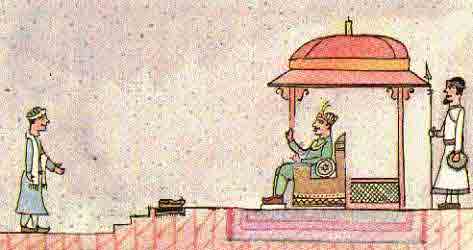 When
Tansen heard of this, he went to the elephant, which was chained and struggling
with the trainers.
When
Tansen heard of this, he went to the elephant, which was chained and struggling
with the trainers.
He began to play the tanpura and sing. Gradually the elephant became calm, and
soon the emperor was able to mount and ride it. Emperor Akbar bestowed honours
and gifts on Tansen. Tansen was given a house very close to the royal palace.
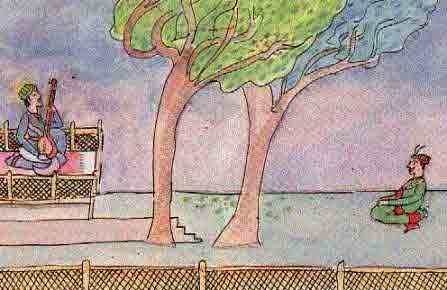
One evening, Emperor Akbar decided to visit Tansen. When the Emperor arrived,
Tansen was singing and playing the tanpura. The Emperor sat quietly in the
verandah and listened to him.
So pleased was the Emperor with Tansen's music that after the performance he
took off his diamond necklace and presented it to Tansen.
Some courtiers became very jealous of the Emperor's high regard for Tansen. They
began plotting Tansen's downfall.
They stole the diamond necklace given by the Emperor and told him that Tansen
had sold it for a large sum of money.
When summoned to the royal court and asked to produce the necklace, Tansen was
unable to do so.
The Emperor flew into a rage. "You will be banished from the court till you can
present yourself wearing the necklace," roared the Emperor.
Tansen was in disgrace. He had no one to turn to. At last he thought of King
Ramchandra and set off for Rewa.
Ramchandra welcomed his former court musician. After hearing the whole story,
the king said, "Don't worry. Just sing for me."
Tansen sang two beautiful ragas for the king.
"Your singing is now superb. You have brought me great joy," said Ramchandra.
And as a token of appreciation, he presented his jewelled sandals to Tansen.
Tansen rushed back to Agra and placed the jewelled sandals in front of the
Emperor. "Sire, please take the diamonds from these and forgive me."
The jewelled sandals were worth much more than the necklace. The Emperor
immediately realized that he had misjudged Tansen and said, "Your music is much
more valuable than diamonds to me. I should never have doubted you. You may
return to the court as my royal musician."
Tansen's fame spread far and wide. People said Tansen was the greatest singer to
have been born in a thousand years. Tansen's enemies once more grew jealous and
began to plot his downfall. They suggested to the Emperor that he command Tansen
to sing Deepak Raga for him.
Deepak Raga was one of the most difficult ragas to sing. Besides, so much heat
would be caused by a perfect rendering of this raga that not only would lamps
alight, but the singer's body too would burn to ashes.
When Akbar asked Tansen to sing Deepak Raga Tansen pleaded, "Sire, Deepak Raga
can set the singer himself on fire. But the Emperor would not listen. "If you
are the greatest singer in the land, you must accept this challenge," insisted
Emperor Akbar.
Tansen knew that singing Deepak Raga was dangerous, but he also knew that if
Megh raga, which brings the rain, could be sung at the same time, he would be
saved from the fury of fire.
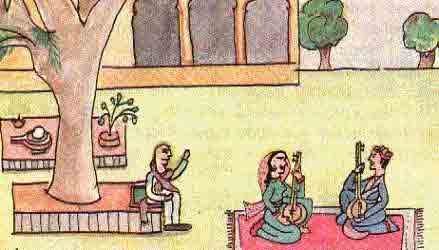
"But how can I sing both ragas at the same time," Tansen thought worriedly to
himself, as he roamed in the garden of his house. Suddenly he had an idea. Maybe
Rupa, a devoted disciple of Haridas, could sing with him.
With the permission of Haridas, Rupa agreed to sing. Rupa was already a very
good musician. Tansen used the fifteen days preparation time, granted by Akbar,
to train her. At the end of the two weeks, Rupa had perfected the singing of
Megh Raga.
On the day of the performance, the court was packed with courtiers and royal
guests. People had come from far and near to hear Tansen sing the most difficult
of all ragas, Deepak Raga.
Unlit lamps were placed on the walls. Tansen was waiting with his tanpura in
hand and, as soon as the Emperor entered and sat on the throne, the great
musician began the alap - the first portion of a raga.
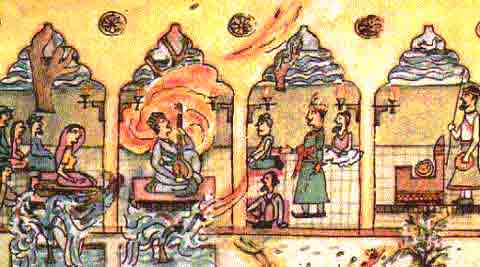 As
Tansen sang on, the surrounding air got warmer and warmer.
As
Tansen sang on, the surrounding air got warmer and warmer.
The audience started perspiring. Leaves and flowers in the garden dried and fell
to the ground. Water in the fountains began to boil. Birds flew away to escape.
The lamps lit up and flames appeared in the air. People fled from the court in
terror. As the Emperor got up and stood, listening with awe, a rose that he
often held in his hand drooped and died.
Now Tansen's body was hot and feverish, but absorbed in Deepak Raga he continued
to sing vigorously.
Seeing Tansen in this state, Rupa became anxious and was unable to start
singing. Then slowly, although waveringly at first, she began singing Megh Raga.
As her voice grew stronger and soared, the sky became dark with clouds. Soon
rain came pouring down. Many among the audience rushed out to be cooled by the
rain. Soon everything returned to normal. People showered praises on Tansen's
genius. Though the Emperor was very pleased, he was shocked that he had almost
lost his greatest musician to the fire of the singer's own music.
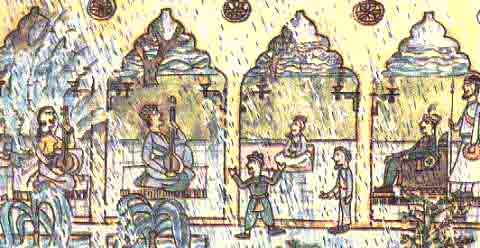 Tansen's
fame now spread like the flames of Deepak Raga.
Tansen's
fame now spread like the flames of Deepak Raga.
For the singer himself, however, the internal fire lit by Deepak Raga did not
cool easily. Tansen fell ill and it was two months before he could return to the
court.
Tansen sang and taught in Emperor Akbar's court for many years. He was not only
a musician, but also a poet. He wrote the words for his music and composed many
new ragas.
When Tansen died Emperor Akbar was at his bedside. The Emperor was filled with
great sorrow. He knew that India had lost her greatest musician and singer. But
Tansen's music has lived on and been passed on from guru to disciple.
And every year in Gwalior, near Tansen's tomb, a music festival is held.
Musicians come here from all over India to perform and pay homage to Tansen.